
The move comes barely two days after the authorities lifted the restrictions in Leh, 22 days after they were first imposed following violent clashes during protests demanding statehood and Sixth Schedule Status that left four persons dead and 90 injured on September 24.
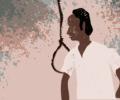
Booth-level officers in Kerala boycotted work following the suicide of a colleague allegedly due to work strain related to the Special Intensive Revision exercise. Trade unions and political leaders are demanding investigations and changes to the process.
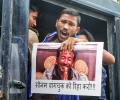
The Supreme Court has sought responses from the Centre and the Ladakh administration regarding the detention of climate activist Sonam Wangchuk under the National Security Act (NSA). Wangchuk's wife has filed a plea challenging the detention, claiming it violates his fundamental rights. The court has given the Centre and Ladakh administration 10 days to respond and has scheduled the next hearing for November 24.

Senior citizens are particularly vulnerable due to their high savings, trust in authorities, and limited familiarity with online frauds.

The district court in Shimla on Thursday upheld the municipal commissioner court's decision to demolish the entire structure of Sanjauli mosque, rejecting a plea by the Himachal Pradesh Waqf Board and the Sanjauli Mosque Committee.
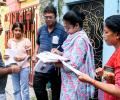
The Election Commission has defended its Special Intensive Revision of electoral rolls in West Bengal and Tamil Nadu in the Supreme Court, refuting allegations of mass deletion of genuine voters as exaggerated and politically motivated.
An advocate has requested the Attorney General's consent to initiate criminal contempt proceedings against a lawyer who attempted to throw a shoe at the Chief Justice of India in the courtroom. The incident involved shouting religious slogans and led to the lawyer's suspension.
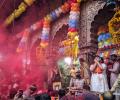
The 'Toshkhana' (treasury) of the Banke Bihari temple in Mathura, locked since 1971, was opened for inspection under the supervision of a Supreme Court-appointed committee. The inventory included copper coins, stones, silver and golden sticks.
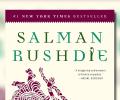
The Supreme Court of India has refused to entertain a plea seeking a ban on Salman Rushdie's controversial novel 'The Satanic Verses'. The court noted that the plea effectively challenged a previous Delhi High Court judgement.
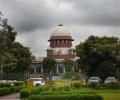
The Supreme Court has directed all states and Union Territories to report on the implementation of guidelines for addressing mental health issues and suicide among students in educational institutions. The Centre has also been asked to file a compliance affidavit.

The cases, brought to light by Team Aid, a non-governmental organisation specialising in repatriation assistance, have sparked calls for urgent government intervention to resolve what campaigners describe as a "humanitarian crisis".

Sporadic violence erupts across Bangladesh as the nation awaits a special tribunal verdict against former Prime Minister Sheikh Hasina in a case of alleged crimes against humanity. Security is heightened, and authorities are on high alert.

The Supreme Court is examining the validity of the Election Commission's decision to conduct special intensive revisions of electoral rolls in several states, focusing on concerns about democratic participation and the burden on ordinary voters.

The Maoists in Bastar went from one village to another with kits providing badly needed medical intervention. The medical help was one key reason why the tribals were attracted to the Maoists, points out M R Narayan Swamy.
'Instead of the government and telecom operators solving the mess of their own creation, they're telling us we need to give access to our phones perpetually.'

SC-appointed Justice Rao recommends striking balance between AIFF autonomy and bidders' interests

The Supreme Court of India has advocated for sex education to be introduced to children at a younger age, rather than starting from Class IX. The court emphasized the importance of educating adolescents about hormonal changes and related precautions.

A Delhi court has reprimanded Tihar Jail authorities for allegedly keeping Christian Michel James, an alleged middleman in the AgustaWestland case, with an inmate who has received 41 punishments for misconduct, raising concerns about Michel's safety. The court also ordered the jail to provide Michel with a table fan, stating that even animals in zoological parks are provided air conditioning. Michel had previously requested to finish his sentence and leave India due to security risks.

The Supreme Court has directed chief secretaries of states and Union Territories (excluding West Bengal and Telangana) to appear on November 3 to explain the lack of compliance affidavits in the stray dogs case.

If the TVK joins the NDA, there is every likelihood of the AIADMK winning an absolute majority in the 234 seat assembly and wanting to form a stand-alone government. In turn, it could mean that the BJP especially and the TVK equally so, will want to restrict the AIADMK's seat share closer to the cut-off figure, if only to ensure that EPS won't get the absolute majority that he desires (if the NDA won, that is) and will have to settle for a coalition government, observes N Sathiya Moorthy.
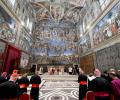
500 years after Britain's then King Henry VIII broke away from the Roman Catholic church over its refusal to sanction his divorce from Catherine of Aragon, 'his successor, King Charles III, prayed with Pope Leo XIV beneath the sublime frescoes of the Sistine Chapel in an act of rapprochement between the Catholic church and the Church of England', The Guardian newspaper reported on Thursday.

Vijay, despite the loud message from his delayed arrival at the road-show/stampede venue, and more so his continued inaccessibility for fans-turned-cadres after graduating from a super-star to a political party leader with electoral ambitions, refuses to change. Or, so it seems, observes N Sathiya Moorthy.

The Supreme Court questioned petitioners who challenged the accuracy of India's COVID-19 vaccine adverse effect data, suggesting they unduly trusted UK figures. The court heard arguments about alleged deaths due to the Covishield vaccine and reserved its order.

Authorities in Bengaluru have sealed the studio premises hosting the Kannada reality show 'Bigg Boss' due to serious violations of environmental regulations cited by the Karnataka State Pollution Control Board (KSPCB).

The Supreme Court issued interim directions permitting the sale and bursting of green firecrackers in Delhi and the National Capital Region (NCR) during Diwali, outlining specific rules and restrictions.

'From the email on record placed before me, it is very difficult to conclude that AIFF had persuaded FIFA to send the emails to enable AIFF to seek for modification of the Constitution.

The Election Commission has warned against the use of bulk SMSes and audio messages during the 48-hour 'silence period' before the conclusion of voting in the Bihar assembly polls. The EC has also mandated pre-certification of political advertisements on electronic media, including social media.
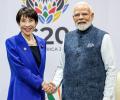
If they act now, they can reshape the strategic map of Asia without firing a shot. If they wait, the next opportunity will come only after a serious Taiwan Strait incident -- by which time the price will be far higher, and the room for boldness far smaller -- the opportunity may well be lost by then. The question is no longer whether this can or should be done, points out Varun Arya.
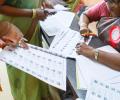
The Election Commission defended its Special Intensive Revision (SIR) exercise for Bihar's voter list in the Supreme Court, calling it accurate and dismissing allegations of impropriety by political parties and NGOs.
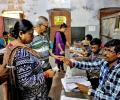
The Supreme Court has requested the Election Commission to respond to petitions challenging the Special Intensive Revision of electoral rolls in Tamil Nadu and West Bengal. The court has also asked the Madras and Calcutta High Courts to keep proceedings on similar petitions in abeyance.

The Supreme Court has directed the Election Commission to address typographical errors and other mistakes in the final Bihar electoral roll. The court will hear further arguments on November 4.

The Supreme Court acknowledged a clean chit from a special investigation team (SIT) regarding the Vantara zoological rescue and rehabilitation centre in Gujarat's Jamnagar, following allegations of irregularities.

The Supreme Court declined to initiate contempt action against a lawyer who hurled a shoe at the Chief Justice of India, citing the CJI's own refusal to proceed against him. The court is considering guidelines to prevent such incidents.

'Government cannot pick and choose as to against whom they want to take action and against whom they do not want to take action.'

The Supreme Court delivered a split verdict on a plea by the Maharashtra government seeking a review of the court's earlier direction to form a special investigation team (SIT) with Hindu and Muslim officers to investigate the 2023 Akola communal riots. Justice Sanjay Kumar refused to review the direction, while Justice Satish Chandra Sharma agreed to hear the review plea in open court.
The ruling means no fresh elections will be held, a move vital for Indian football since a mid-term poll could have triggered FIFA's wrath and another suspension for "third-party interference."
Climate activist Sonam Wangchuk's wife, Gitanjali J Angmo, claims his speeches were quoted out of context and wrongly translated to support an 'anti-national narrative' in his detention order. She asserts the charges are frivolous and will be challenged in court.
'We have already said that our judgment is only in the interregnum till the Act comes into play. These small things could have been easily taken care of. Anyway, we will seek the views of Justice Rao and issue a clarification.'
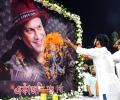
A petition has been filed in the Supreme Court seeking transfer of the probe into the death of Assamese singer Zubeen Garg from the state police's SIT to a central agency such as the CBI or the NIA.

The Supreme Court rejected a PIL challenging the nationwide rollout of 20% ethanol-blended petrol (EBP-20), citing benefits to sugarcane farmers. The plea alleged incompatibility issues with older vehicles.
 © 2026 Rediff.com - Advertise with us - Disclaimer - Privacy Policy - Sitemap - Feedback - About us - Terms of use - Grievances